
For most plaintiff law firms, referrals are already the top source of new business. Co-counsel networks, primary care physicians, chiropractors, social workers, union reps — the relationships are there. The problem is almost never finding partners. It's managing them once you have them.
Informal referral programs fail quietly. A partner submits a lead, waits three weeks for an update, and quietly stops sending cases your way. Fee agreements live in email threads. Your intake team doesn't know which leads came from whom. By the time you realize a relationship has gone cold, the cases are already going somewhere else.
A formal referral partner program changes that. Here's how to build one that scales — and what to put in place to make sure it holds together over time.
Step 1: Define Who Your Partners Are
Not all referral sources are equal, and not all of them should be managed the same way. Start by mapping your existing referral relationships into categories.
Attorney & Co-Counsel
Lawyers who send cases outside their practice area. Highest case value, most formal fee agreements. Must comply with state bar fee-sharing rules.
Medical & Professional
Physicians, chiropractors, physical therapists, social workers, and case managers. Steady inbound channel; relationships are built on demonstrated reliability, not fees.
Community & Organizational
Union reps, advocacy nonprofits, immigrant services organizations. High-volume for workers' comp and employment practices; relationships are earned over years.
Each category requires a different approach to onboarding, communication, and compensation. The firms that build strong programs treat these as distinct tracks — not one-size-fits-all partnerships.
Step 2: Formalize Every Agreement
The single biggest operational gap in most law firm referral programs is the absence of written agreements. A handshake deal might feel fine when the relationship is new. It becomes a source of conflict the moment a high-value case comes through.
What a Referral Agreement Should Cover
- Scope of the relationship — which case types are included, any geographic limitations
- Fee structure — flat fee, percentage of attorney fees, or case-by-case negotiation
- Trigger for fee payment — when fees are owed (retainer signed, case resolved, funds collected)
- Exclusivity terms — is this partner sending all cases of this type to you, or working with multiple firms?
- Duration and termination — how long the agreement runs, and what happens to in-flight cases if it ends
- Confidentiality — how client data shared during the referral process will be handled
Attorney referral rules vary by state
For attorney co-counsel agreements, your written agreement must also comply with your state bar's fee-sharing rules. Most jurisdictions require written client consent and either joint responsibility or a division of services between referring and receiving counsel.
Build a Template Library
Once you've drafted your first few agreements, templatize them. You should have a standard attorney co-counsel agreement, a professional referral agreement, and a community partner agreement. New partners get onboarded on a standardized document — not a negotiated one-off every time.
Step 3: Give Partners a Way to Submit and Track Leads
Here's where most informal programs break down the hardest. A partner wants to send you a case. What do they do — email you? Text? Call the front desk and hope someone writes it down?
Every friction point in the submission process is a referral you don't capture.
The Partner Experience Matters
Your referral partners are doing you a favor by sending cases your way. If the experience of submitting and tracking a referral is painful, they'll find a firm where it isn't. What partners actually want is simple:
Fast submission
A simple, direct way to submit a new lead — ideally under two minutes, no login to your internal systems.
Lead visibility
Real-time status on every case they've referred — not "let me check and get back to you."
Fee transparency
A clear view of their accumulated fees and payment status — no chasing invoices.
A dedicated partner portal — even a simple one — signals that you take the relationship seriously. It removes back-and-forth emails and gives your partners confidence that their leads are landing somewhere organized.
Keep internal and partner access separated
Partners should see only what's relevant to them: their own leads, their own fee records, their own relationship with your firm. No access to your broader intake pipeline, other clients, or other partner relationships. For many firms, that separation is an ethical requirement — not just good practice.
Step 4: Track Every Lead From Source to Signed Retainer
A referral program is only as valuable as your ability to measure it. If you can't trace a signed client back to the partner who referred them, you can't pay fees accurately, you can't identify your best partners, and you can't make data-driven decisions about where to invest.
Tag Every Intake at the Source
When a lead comes in from a referral partner, it needs to be tagged to that partner at the moment of intake — not reconstructed later from notes. Build partner attribution into your intake workflow, not as an afterthought.
Track Status Across the Full Lifecycle
A referred lead can move through several stages. Partners should be able to see where every case stands — that visibility is a retention mechanism that keeps them engaged with your firm rather than wondering what happened to their referrals.
Received
Submitted by the partner, not yet reviewed by your intake team.
Under Review / Contacted
In your intake qualification process or your team has reached out to the claimant.
Signed
Retainer executed — fee obligation triggered for the referring partner.
Declined / Referred Out
Didn't meet your criteria, or sent to another firm better suited to the case type.
Automate Fee Tracking
Manual fee tracking is a liability. When a signed retainer triggers a fee obligation, that record should be created automatically — based on the fee agreement you established during onboarding — not by someone remembering to update a spreadsheet. The same logic applies to marking fees paid: timestamps, partner attribution, and payment confirmation should all be captured without manual data entry.
Step 5: Measure What's Working
A mature referral program generates data that tells you exactly where to focus your relationship-building energy.
Partner-Level Metrics That Matter
- Volume — how many leads has this partner sent over time?
- Quality — what percentage of their leads meet your intake criteria?
- Conversion rate — what percentage of qualified leads become signed clients?
- Case value — what's the average expected value of cases they refer?
- Cycle time — how long from referral to signed retainer for their cases?
The partners with high volume and high quality are your most valuable relationships. Invest in them accordingly — regular check-ins, faster response times, priority onboarding for their leads. Partners with high volume but low quality are worth a conversation: either your intake criteria aren't well-communicated to them, or the relationship isn't the right fit.
Firm-Level Reporting
Roll partner data up into firm-level reporting that answers the questions your managing partners actually ask:
- What percentage of new cases came from referral partners this quarter?
- What is the total fee liability outstanding to referral partners?
- Which practice areas have the strongest referral pipelines?
- Are we growing or losing referral volume year-over-year?
This data makes the ROI of your partner program legible to leadership — which makes it easier to justify investment in maintaining and growing it.
Putting It Together with Case Compass
Case Compass's Referral Partner module was built to support exactly this kind of structured program — without requiring a separate CRM, a shared spreadsheet, or a custom-built portal.
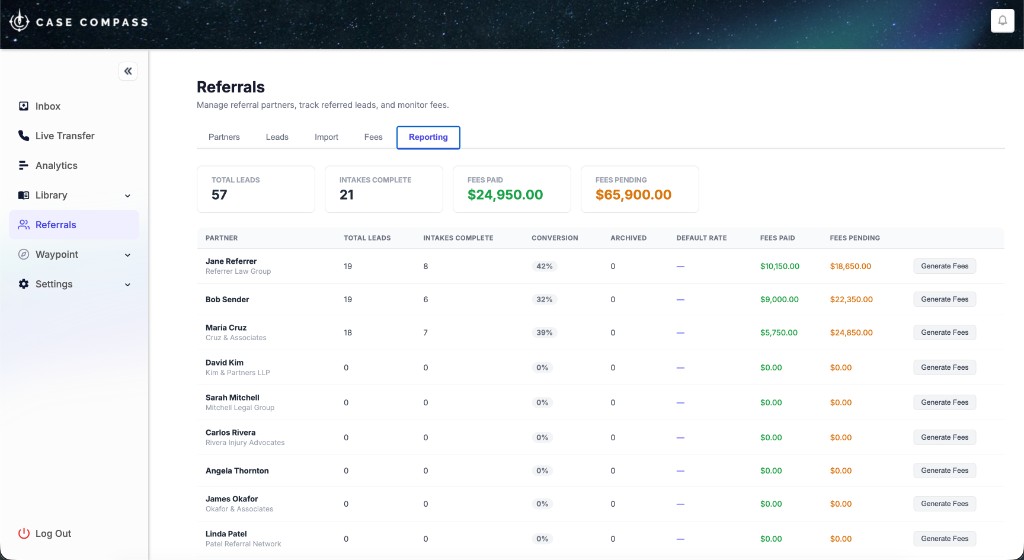
The Referrals Reporting tab — partner-level conversion rates, fee totals, and one-click fee generation.
From inside Case Compass, you can:
- Add referral partners and configure their fee agreements during onboarding
- Attribute any intake to a partner at the time of submission
- Give partners a branded portal to submit new leads and track case status — no access to your internal dashboard required
- Auto-generate fee records when a referred intake is signed
- Run partner reporting that shows volume, quality, and conversion by partner over any time period
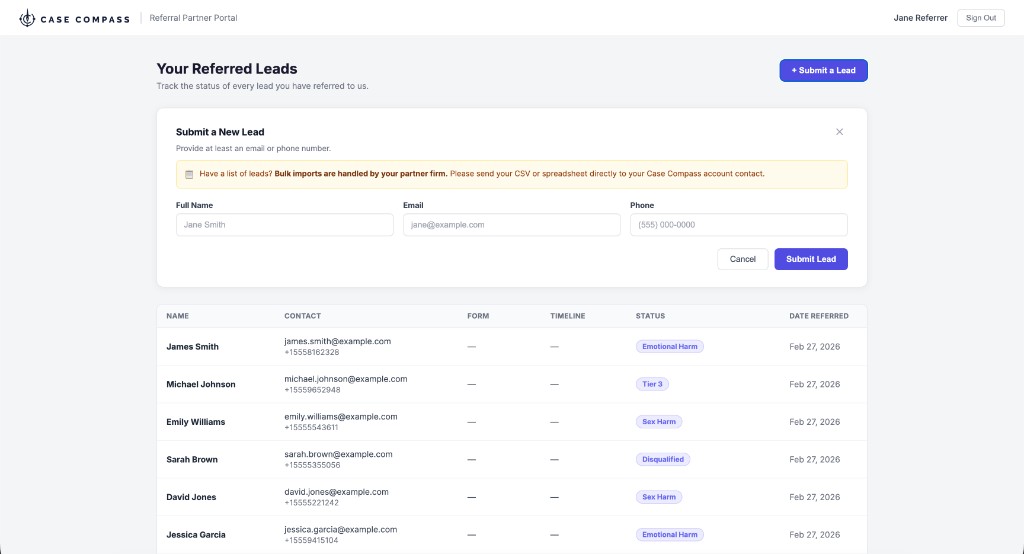
The partner-facing portal — leads submitted, statuses updated, fully transparent. No access to your internal Case Compass instance.
If you're already using Case Compass for intake, adding a formal referral partner program is a matter of configuration — not a separate implementation project.
Getting Started
If you're formalizing a referral program for the first time, start simple:
- List your top five current referral sources and formalize those agreements first.
- Build a standard intake flow that captures partner attribution on every lead.
- In Case Compass, navigate to Referrals → Partners and add each partner with their fee structure.
- Share the partner portal link — they can submit leads and track status immediately.
- Set up a reporting cadence — monthly partner performance, quarterly fee reconciliation.
- Expand from there as you learn what's working.
The firms that do this well don't necessarily have the largest partner networks. They have the most organized ones. Partners stay because the experience of working with your firm is better than the alternative — and that starts with being able to track, communicate, and pay on every case they send you.
Frequently Asked Questions
What types of referral partners should a law firm pursue?
What should a law firm referral agreement include?
How should a law firm track referral leads?
What metrics matter most for measuring referral partner performance?
How does Case Compass support referral partner management?