When someone searches for "legal intake software," they usually mean one of two things: a tool that replaces the manual phone-and-email intake process, or a platform that automates the entire path from first contact to signed retainer. The gap between those two definitions is where most law firms get into trouble — buying a tool that handles one piece of intake and then discovering everything around it is still manual.
This guide breaks down what legal intake software is, what full legal intake services look like end-to-end, and what plaintiff firms should actually evaluate when choosing a platform.
What is legal intake software?
Legal intake software is a purpose-built platform that automates how a law firm moves a potential client from initial inquiry to signed retainer. At minimum, that means capturing contact information and case details. At the full end of the spectrum, it means:
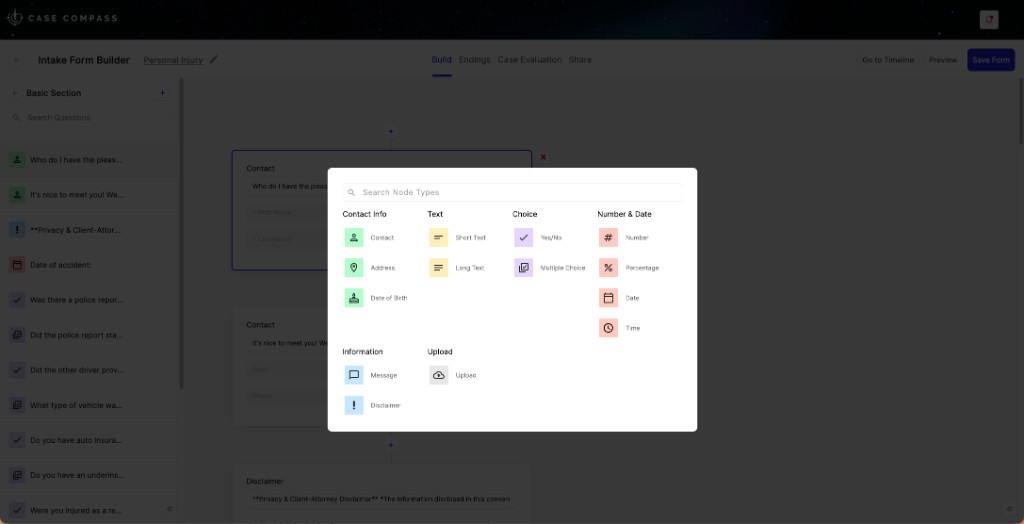
- Collecting case-specific information through branching intake flows (not flat forms)
- Scoring leads with AI against your firm's criteria before any human reviews them
- Routing high-scoring leads to a live intake agent in real time
- Triggering automated follow-up (SMS and email) within seconds of submission
- Presenting a pre-filled retainer for e-signature in the same session as intake
- Syncing the complete intake record to your CMS — Filevine, Clio, Litify, LeadDocket — automatically
Most tools on the market handle one or two of those steps well. The distinction between a legal intake tool and a legal intake platform is whether the entire flow runs in a single connected system, or whether your team is manually bridging gaps between separate products.
The core test
Can a potential client go from first inquiry to signed retainer without your staff manually touching the lead? If yes, you have intake software. If no, you have a data collection tool.
What are legal intake services?
"Legal intake services" is sometimes used to describe outsourced intake — third-party call centers that screen leads on behalf of a law firm. But it also refers to the full set of capabilities a firm needs to convert inquiries into signed clients. Those services, whether delivered by software, by staff, or by both, include:
Lead capture
Collecting initial contact information and case details — via chatbot, webform, landing page, or phone.
Case qualification
Asking the right follow-up questions — exposure dates, diagnosis type, injury details — before a human reviews the lead.
AI lead scoring
Evaluating every submission against firm-defined criteria to produce a case quality score before staff review.
Live transfer routing
Connecting high-scoring leads directly to available intake staff in real time, while intent is still high.
Automated follow-up
SMS and email sequences that fire within seconds of intake submission — not when someone checks the queue.
E-signature retainer
Presenting a pre-filled retainer agreement as the next step in intake — closing the case before the client leaves the flow.
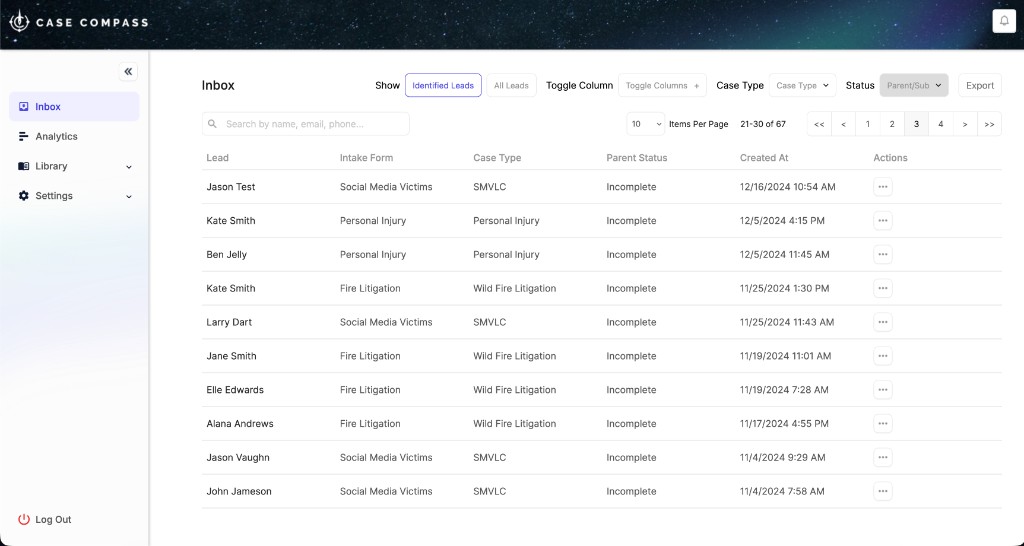
The Case Compass intake inbox — every lead arrives pre-scored with case quality, source channel, and recommended next action already surfaced.
Legal intake software vs. manual intake: the real cost gap
Manual legal intake — a staff member calls back every form submission, screens them verbally, then routes the qualified ones to an attorney — works at low volume. It breaks down in three places as volume grows:
Speed to lead. Response time within the first five minutes after a potential client submits is a critical conversion driver. Manual intake rarely achieves that — form submissions queue up, and by the time someone calls back, the lead has moved on or signed with another firm. Legal intake software triggers follow-up in seconds, not hours.
Staff time on unqualified leads. In a manual intake operation, your team screens every submission — including the ones that fail on the first qualifying question. Legal intake software applies branching qualification logic before the lead reaches your staff, so the first time a human touches the record, it's already pre-screened.
Time to retainer. Manual intake creates a gap between intake call and signed retainer — an email with a DocuSign link, a follow-up reminder, a second call. Cases are lost in that gap. Legal intake software compresses it: a qualified lead can go from intake submission to signed retainer without a human in the loop.
The question to ask your team
Of all the leads you received last month, how many were disqualified on the first screening question? That percentage of your staff's intake time is recoverable with software.
Core features to evaluate in legal intake software
Not all legal intake software covers the same ground. Here's what to look for when evaluating platforms — particularly for plaintiff firms running personal injury, mass tort, or workers' comp campaigns.
Branching qualification logic
A flat form collects the same fields from everyone. Branching logic asks different follow-up questions based on each answer — so a Depo-Provera campaign asks about injection history and meningioma diagnosis, while a car accident campaign asks about fault, injuries, and insurance. Each potential client only sees the questions relevant to their situation, which improves completion rates and pre-screens in a single pass.
AI lead scoring
The most valuable thing legal intake software can do for a high-volume plaintiff firm is score every lead before a human opens it. AI scoring — like Case Compass's Waypoint engine — evaluates each intake against firm-defined criteria: injury severity, exposure timeline, case value indicators, and statute of limitations. Your team reviews leads ranked by case quality, not in the order they arrived.
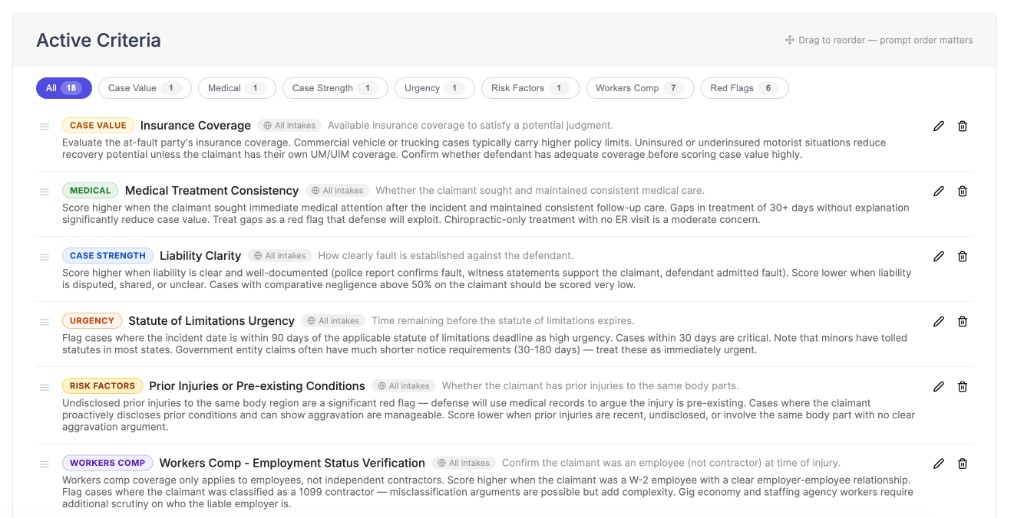
Waypoint AI scoring — each intake is evaluated against firm-defined criteria and scored before your team opens the lead record.
Live transfer routing
For plaintiff firms running paid campaigns, speed is a competitive advantage. Live transfer connects a qualified lead to an available intake agent in real time — within the same session as their initial inquiry. The agent receives a pre-populated intake record with everything already collected, so the call starts on qualification, not data gathering.
Automated follow-up sequences
Every lead that isn't routed to live transfer needs immediate automated follow-up. Legal intake software should trigger SMS and email sequences the moment a form is submitted — not batch them for review. Sequence timing, message content, and stopping conditions (reply received, retainer signed) should all be configurable without developer support.
In-session e-signature retainers
The single biggest driver of retainer conversion is presenting the retainer agreement at the moment of highest intent — immediately after a qualifying intake is complete. Legal intake platforms with built-in e-signature eliminate the delay and attrition that comes with sending a retainer later. The retainer is pre-filled from intake data and presented as the next step in the same flow.
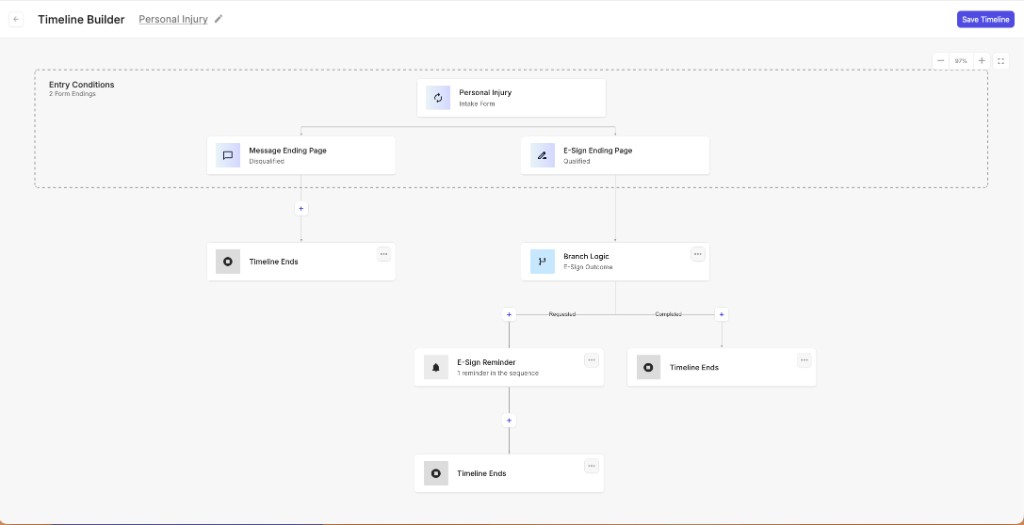
Case Compass Timeline Builder — qualified leads route directly to e-sign; an automated reminder sequence fires if the retainer isn't completed within the first session.
CRM and CMS integration
Legal intake software that doesn't connect to your case management system creates a manual data entry step at the end of every case. Look for native integrations with Filevine, Clio, Litify, SmartAdvocate, and LeadDocket — not just a generic webhook or Zapier connection. The intake record, scoring data, intake source, and signed retainer should all sync automatically when a case is created.
Legal intake software by practice area
Generic intake tools aren't built for the specifics of plaintiff practice. The qualification criteria for a mass tort MDL campaign are fundamentally different from a single-event personal injury case. Here's how intake requirements differ across practice areas — and what your software needs to support.
Personal injury intake
PI intake typically focuses on: fault determination (police report, insurance information), injury type and severity, medical treatment received, and lost income or disability. The disqualification criteria are usually statute of limitations and minimum injury threshold. Live transfer matters most here — PI leads are highly competitive and time-sensitive.
Mass tort and MDL intake
Mass tort campaigns require the most precise intake qualification. Specific product exposure windows, diagnosis types, and treatment records are often required to determine MDL eligibility. A Depo-Provera campaign needs injection history and meningioma diagnosis confirmed before any human reviews the lead. An IVC filter campaign needs implant brand and complication type. Legal intake software for mass torts must support campaign-specific qualification templates and high-volume scoring — often hundreds of submissions per day.
Workers' compensation intake
Workers' comp intake is often disqualified at the employer level — if the employer had no coverage, or if the injury occurred outside the course of employment, the case may not be viable. Software that supports jurisdiction-specific and employer-specific branching reduces the screening burden significantly for high-volume workers' comp practices.
How Case Compass delivers legal intake services end-to-end
Case Compass is a legal intake platform built specifically for plaintiff law firms. The full intake flow — from first contact to signed retainer — runs inside a single system:
- Capture — Chatbot, embedded webform, or landing page captures the initial inquiry. Deployable on any existing website without a rebuild.
- Qualify — Branching intake flows collect practice-specific case details. No flat forms; each answer shapes what comes next.
- Score — Waypoint AI evaluates the completed intake against your firm's scoring criteria and produces an overall case quality score before any human touches the record.
- Route — High-scoring leads trigger live transfer to your intake queue. Other leads enter automated SMS and email nurture sequences.
- Close — Qualified leads receive a pre-filled retainer agreement via Case Compass's built-in e-signature, presented as the final step in intake.
- Sync — The signed case, intake record, and score push directly into Filevine, Clio, Litify, or LeadDocket with no manual entry.
Live in one week
Onboarding is included. Case Compass builds your intake flow, configures Waypoint scoring for your practice area, and deploys your first campaign. Most firms are live in under a week with no developer work required.
What to look for when evaluating legal intake software in 2026
The market has fragmented — there are generalist form tools, legal-specific CRMs with intake modules, and purpose-built intake platforms. Here's how to evaluate them for a plaintiff firm's actual needs:
- Does it qualify, or just collect? A tool that captures flat fields is not intake software. Branching logic that asks practice-specific follow-up questions is.
- Is AI scoring built in or bolted on? Scoring that lives inside the same platform as intake — not a separate API integration — ensures every lead is scored before staff review, not just occasionally.
- Can it close a retainer in the same session? If the e-signature step requires a separate tool, there's a gap in the flow where leads are lost.
- How does it handle live transfer? Queue management, agent availability, callback routing, and real-time lead data all matter for plaintiff firms that compete on speed-to-contact.
- What does attribution look like? You need to trace signed clients back to specific campaigns, channels, and landing pages — not just form submissions.
- Does it support mass tort workflows? If you run MDL campaigns, verify the platform supports campaign-specific qualification templates and the volume they generate.
See legal intake software in action
We'll walk you through a complete Case Compass intake flow — capture, scoring, live transfer, e-signature — live, with your practice area's qualification criteria.
Schedule a Demo →Frequently asked questions about legal intake software
What is the difference between legal intake software and a CRM?
A CRM stores and manages leads after they've been captured. Legal intake software handles the front of that process — qualification, scoring, routing, and retainer closing. Many CRMs include basic intake forms, but they don't ask branching follow-up questions, run AI scoring, manage live transfer queues, or present a retainer for signature in the same session. Legal intake software and a CRM serve different parts of the funnel; most plaintiff firms use both, with intake software feeding structured data into the CRM.
How much does legal intake software cost?
Pricing varies significantly depending on capabilities and volume. Basic single-channel tools (simple chatbots or contact form replacements) run $50–$200/month. Full intake platforms with AI scoring, live transfer, e-signatures, and CRM integrations typically run $500–$2,000+/month. The right way to evaluate cost is cost per signed client, not monthly subscription — purpose-built intake platforms reduce the cost per signed client by eliminating manual screening time and improving retainer conversion rates.
Can legal intake software replace an outsourced intake call center?
For lead volume that was previously handled by an outsourced intake call center, legal intake software can take over the qualification, scoring, and retainer steps — reducing or eliminating the call center cost for cases that don't require live human interaction. High-complexity cases and inbound callers still benefit from live intake staff. The most effective model for plaintiff firms is software-first intake (capture, qualify, score, present retainer) with live transfer routing for leads that clear the AI scoring threshold.
What practice areas benefit most from legal intake software?
High-volume plaintiff practices benefit most: personal injury, mass tort and MDL campaigns, workers' compensation, and social security disability. These practices receive large numbers of inquiries that need to be qualified against specific criteria before being worth human review time. Mass tort campaigns — Depo-Provera, AFFF, IVC filters, social media mental health — have particularly precise qualification requirements that software handles more consistently and at lower cost than manual screening.